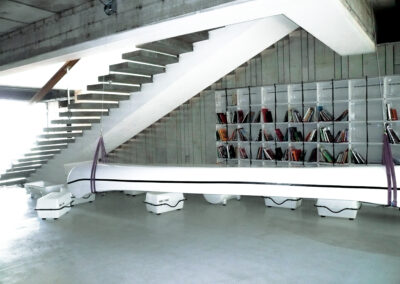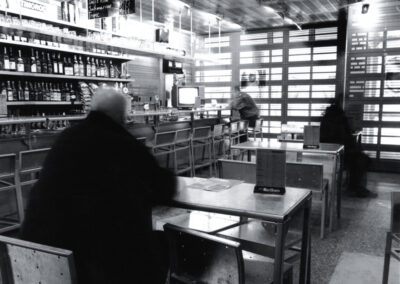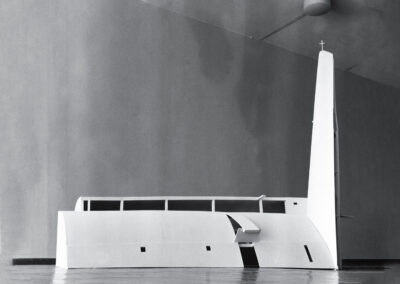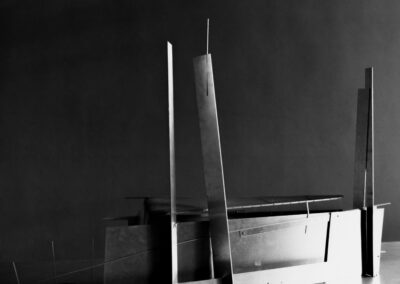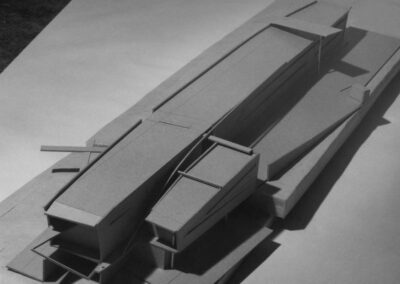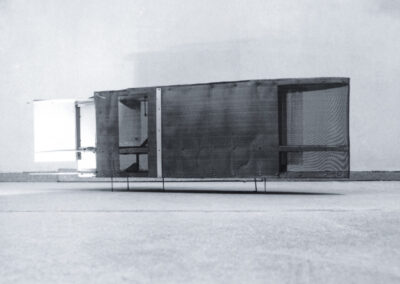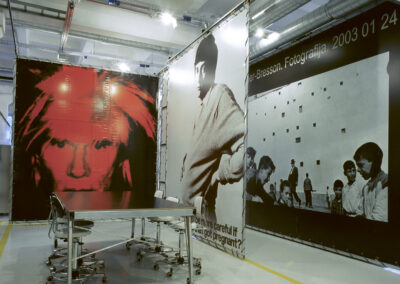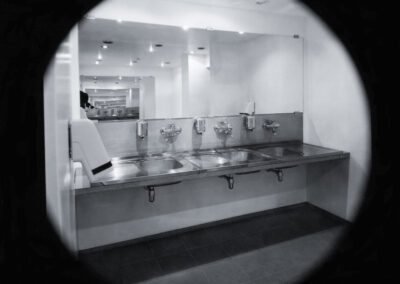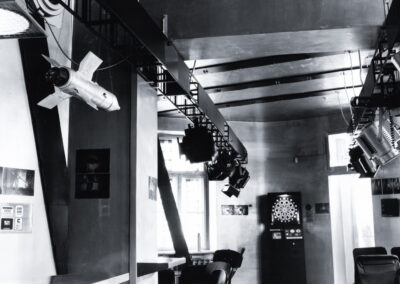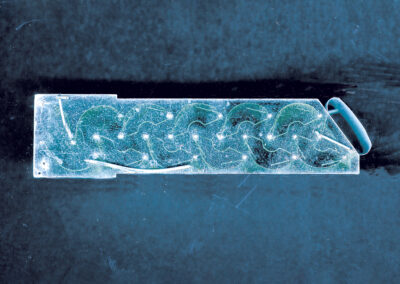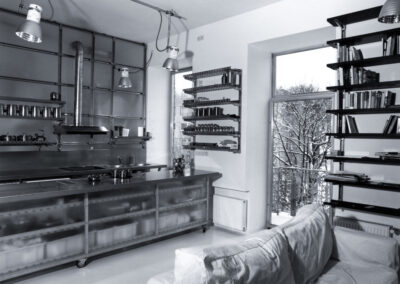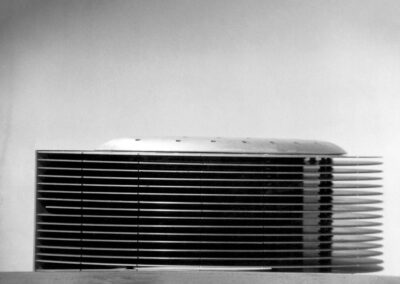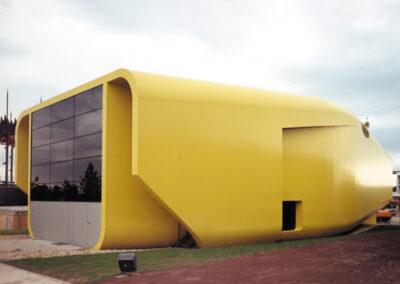
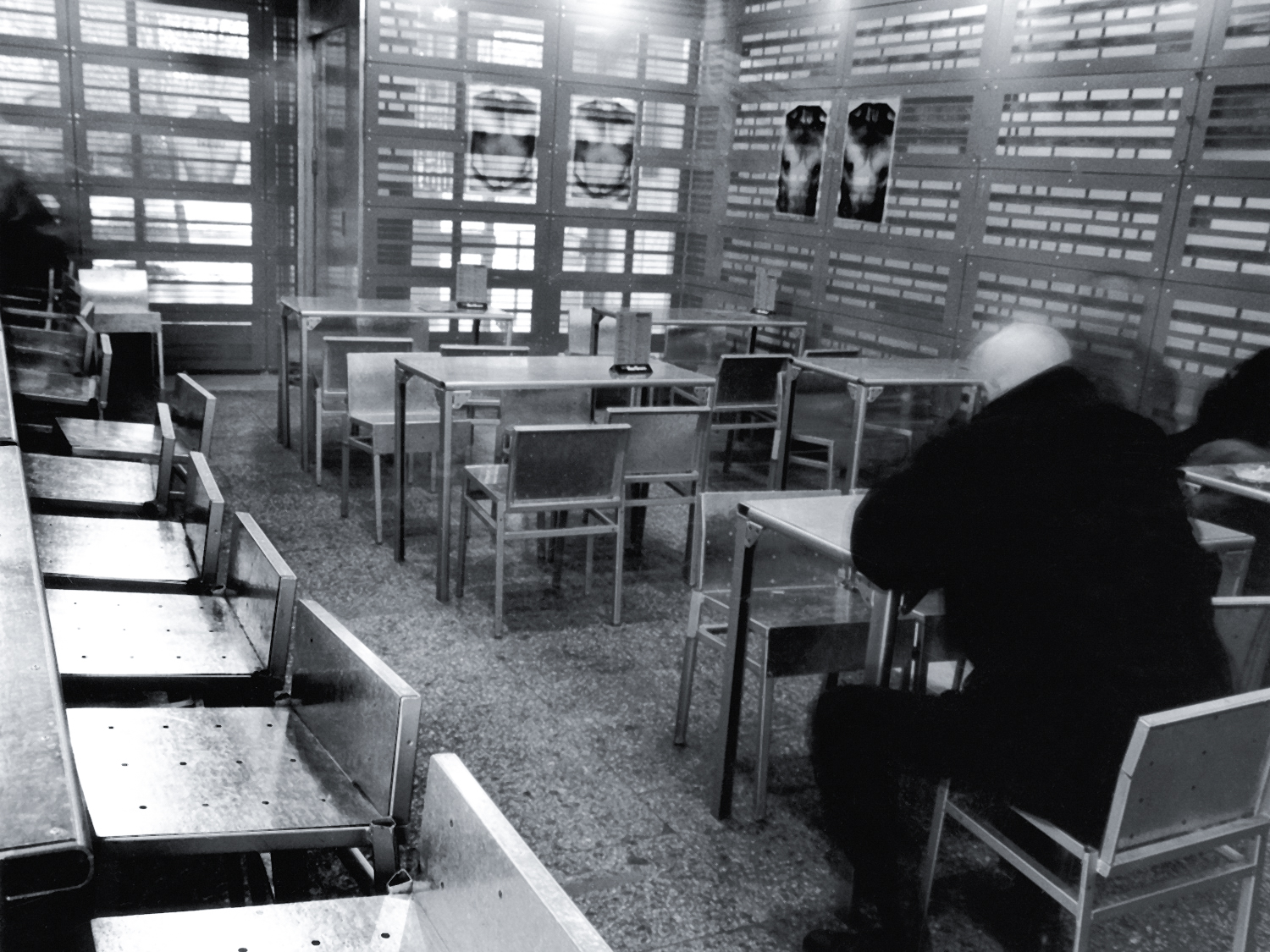
Café Neperšaunama liemenė (Bulletproof Vest), 1996
In his widely circulated 1966 essay ‘Nonstraightforward Architecture: A Gentle Manifesto’, Robert Venturi wrote: ‘I like elements which are hybrid rather than “pure,” compromising rather than “clean,” distorted rather than “straight,” ambiguous rather than “articulated.”’ Venturi presents this manifesto in purely textual form, leaving examples of non-[1] straightforward architecture to the reader’s imagination. In the Lithuanian context, it would be difficult to find a more convincing illustration of Venturi’s ideas than the collaborative work of Valdas Ozarinskas and Aida Čeponytė, with Neperšaunama liemenė (Bulletproof Vest) standing as a benchmark example of a multilayered and authentically vibrant interior.
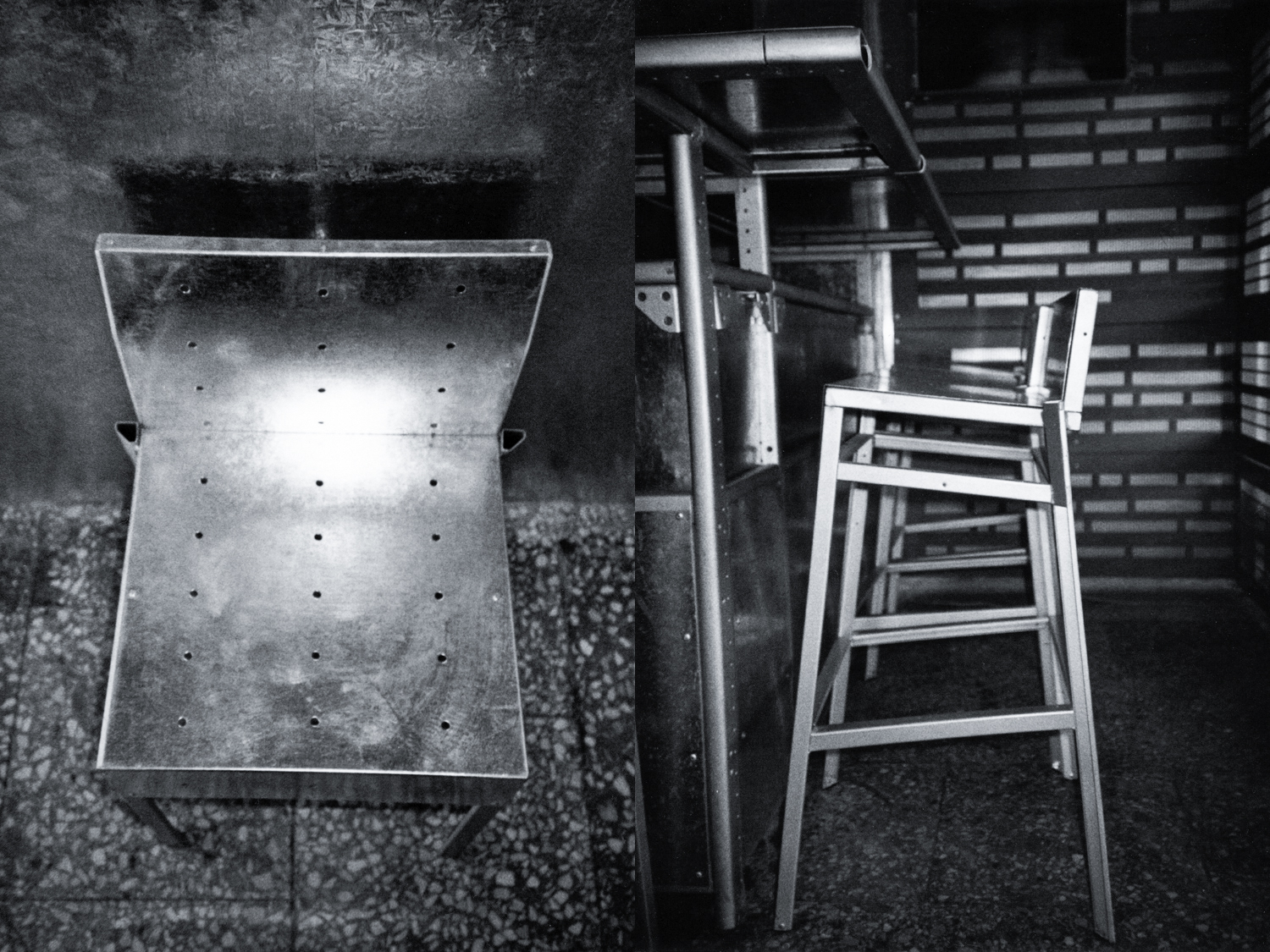
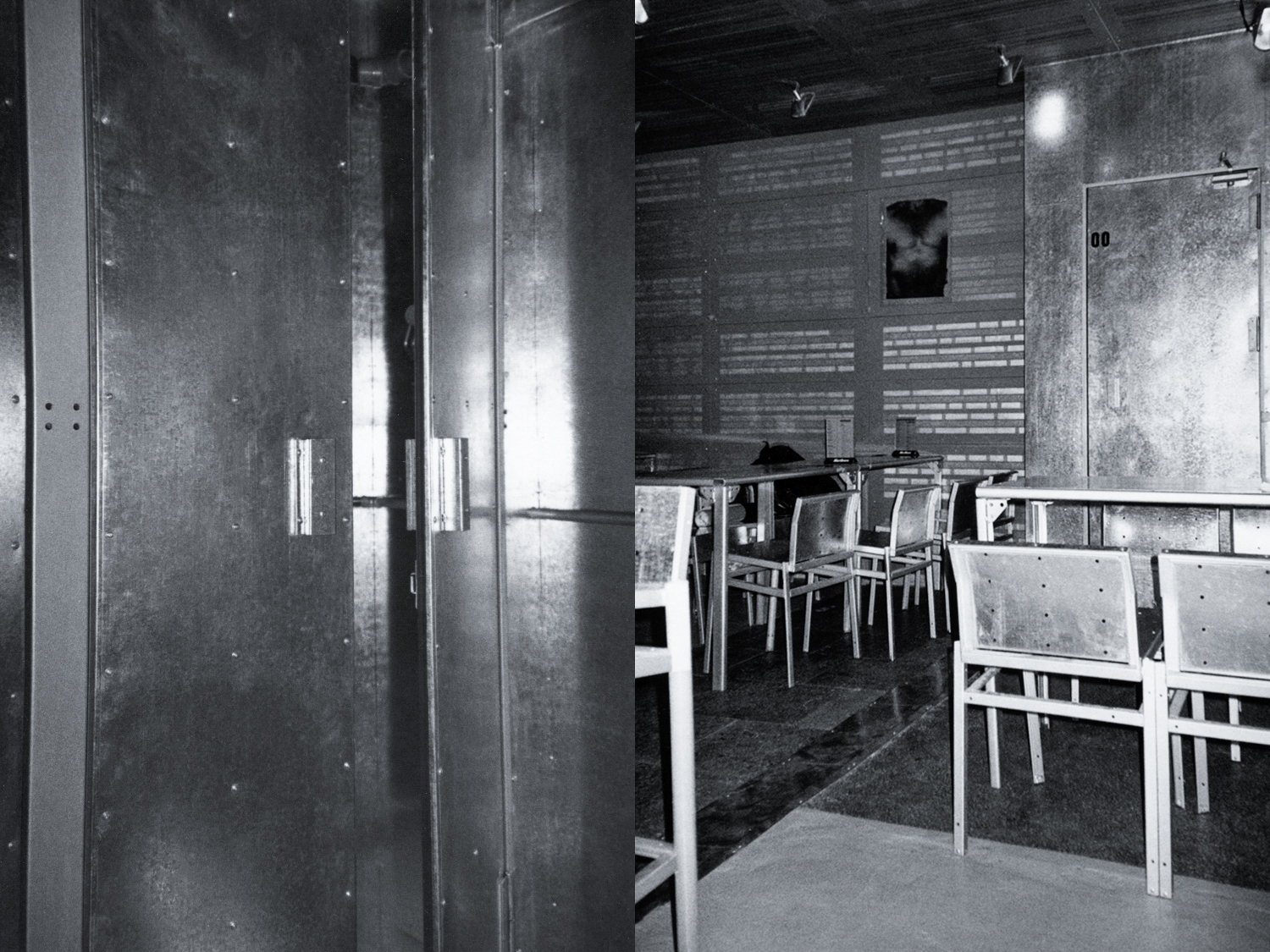
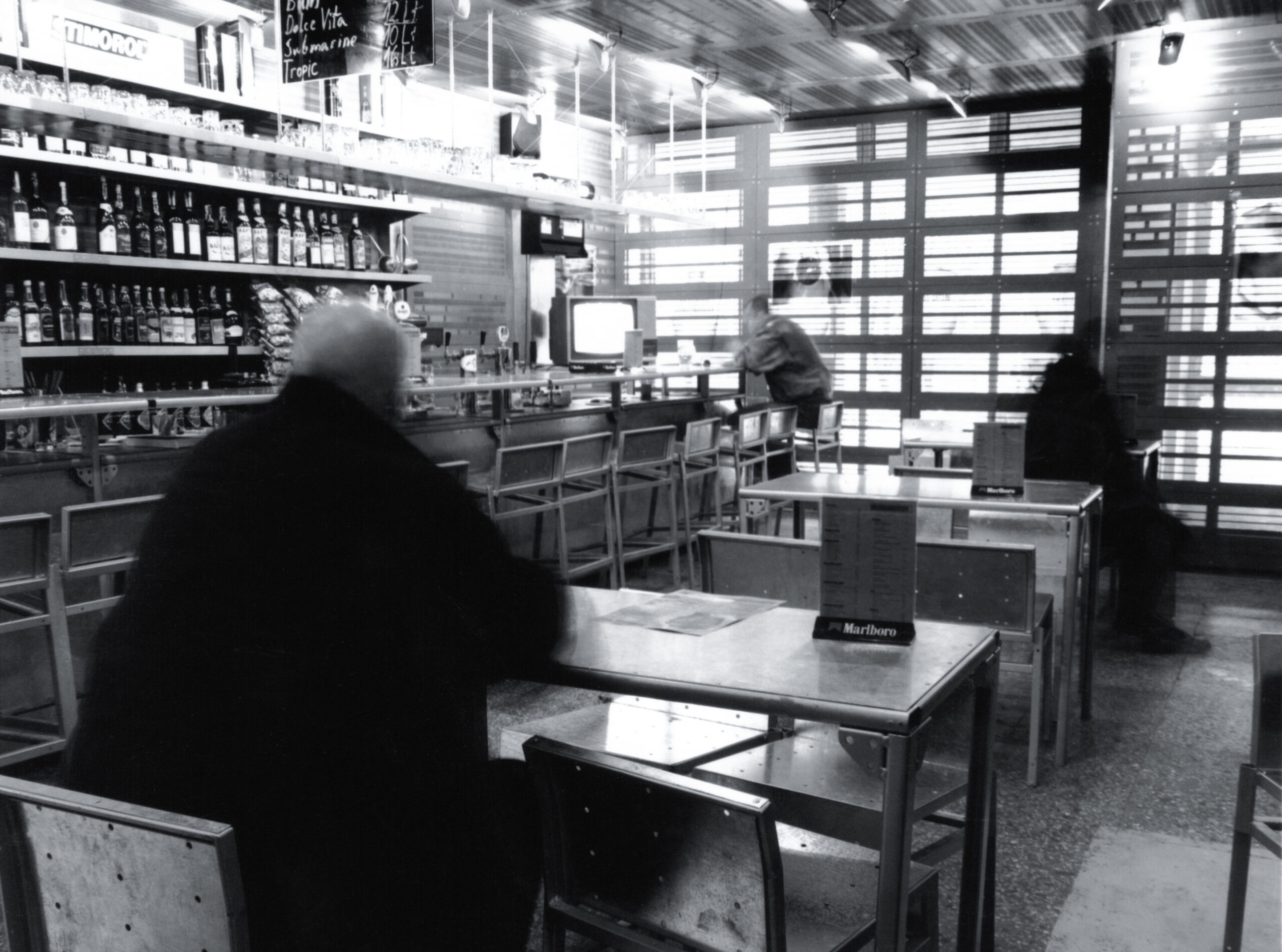
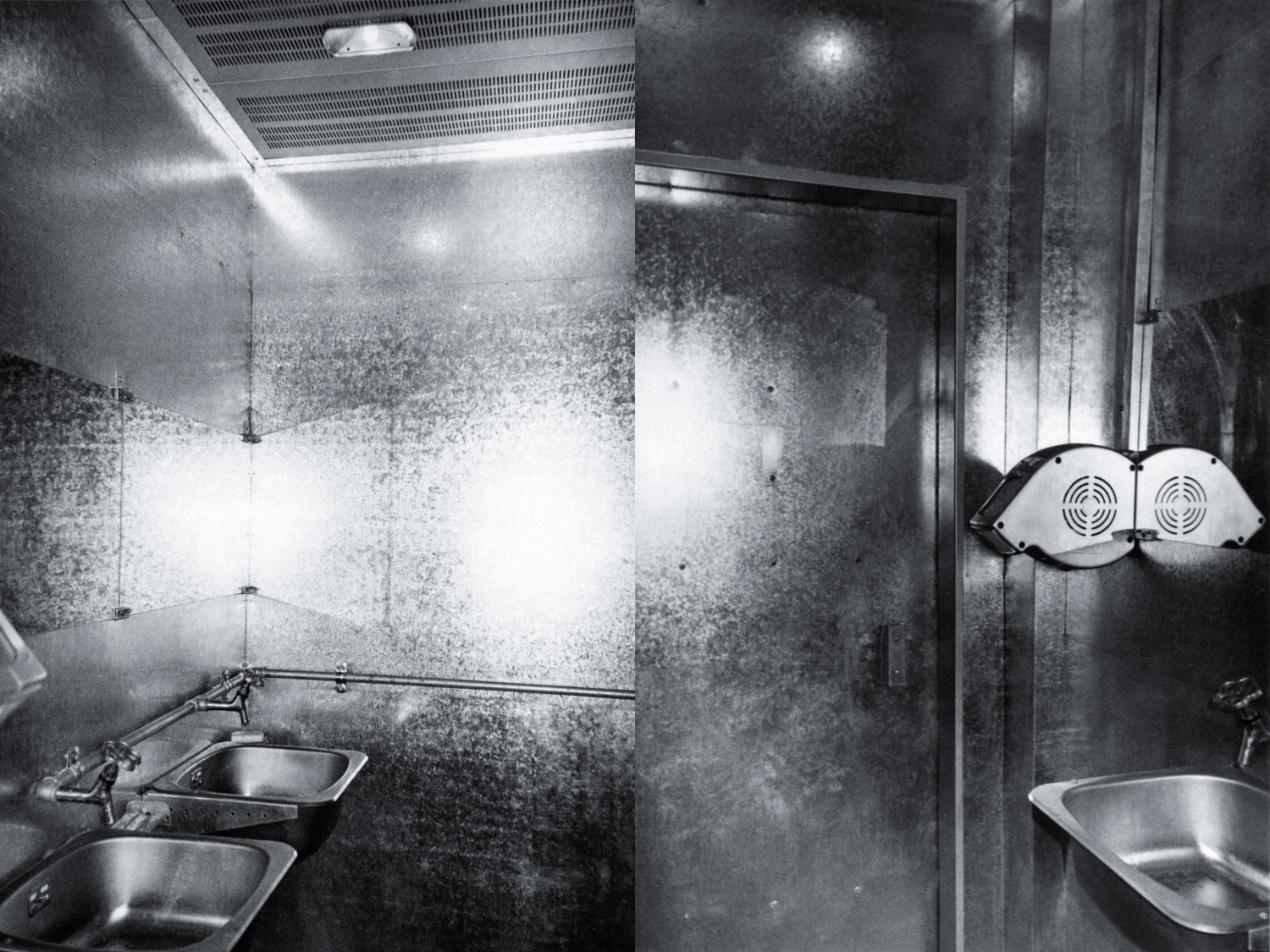
Like NATO’s café, the interior of Neperšaunama liemenė – which existed only briefly in the Lazdynai district of Vilnius – belongs to what is often described as Ozarinskas’s ‘metal period’. Black, steel-toned walls, exposed metal surfaces, militaristic and industrial details, hi-tech furniture, and even stylised waiters’ uniforms created a deliberately ‘tough’ visual atmosphere. A series of photographs featuring muscular male bodies further reinforced the impression that the café engaged in a direct dialogue with the turbulent social realities of the 1990s. In this respect, the interior can be compared to Bernardo Khoury’s nightclub B018 in Beirut,[2] conceived as a reaction to the complex social experience of civil war. In both cases, architecture reflects an uncomfortable, complex, yet undeniably present social condition.
In designing Neperšaunama liemenė, Ozarinskas and Čeponytė sought a subtle dialogue not only with an official, modernising Lithuania – becoming increasingly orderly – but also with its peripheries. Their approach recalls the strategies of the Situationists, who attempted to ‘penetrate the external, spectacular, commercialised signs of mass culture and explore its interior.'[3] The relationship with Soviet industry – and the absorption of its collapse – became one of the key turning points shaping the self-awareness of the emerging society: a forced transition from an industrial to a post-industrial condition, marked by ruined destinies and in which industry itself became a form of creative raw material. This industrial character was expressed not only through materiality but also directly, through a strategy of reuse: the interior was created ‘using metal parts from calculating machines obtained from a gradually dismantled calculating-machine factory, liquidating its inventory.'[4]
Neperšaunama liemenė, like NATO’s, was in many ways a collective intellectual product of its time, in which references, inspirations, and cultural signals intertwined to form a broader phenomenon. One particularly evocative reflection appears in a text by Rolandas Rastauskas, later published in the magazine Nemunas:
The gentlemen of Lazdynai sit on metal benches only in guard-rooms. Ozė [Ozarinkskas – tr. note] had encoded my occasional texts on the walls of Neperšaunama liemenė: dots and dashes shone in place of letters. That decision seemed more logical than the collection of obligatory banalities that eventually became ‘classics’. The bartenders wore cone-shaped metal vests. That year, Allen Ginsberg, Mother Teresa, and Princess Diana passed away.[5]
Yet the project proved too radical for the context of the 1990s. Reflecting on the work in a later interview, Ozarinskas was laconic: ‘Clients are cautious about ultra-modern interiors. In the end, after everything has been done, they decide that they have been deceived.'[6] Perhaps today Neperšaunama liemenė, like NATO’s, can be recalled – borrowing Iain Borden’s words – as a phenomenon of temporary architecture essential to a healthy urban life: architecture created to disappear, leaving no physical trace, only memories and emotional residues in the minds of its users. As Borden writes, ‘In this form, architecture is like a seasonal flower – beautiful in its ephemerality and transience. It is valued not only for what it provides, but also for the awareness that it will soon be gone.'[7]
[1] Venturi R. 1966, Complexity and Contradiction in Architecture, New York: The Museum of Modern Art, p. 16.
[2] Nightclub B018 in Beirut, designed by Bernard Khoury, 1998, http://www.bernardkhoury.com/project.php?id=127
[3] Sadler, S. 1999, The Situationist City, Cambridge, MA; London: The MIT Press, p. 19.
[4] Januškevičiūtė, V., ‘Interiors’, Architektas be architektūros?, Valdas Ozarinskas Retrospective: Exhibition Guide, Vilnius: Contemporary Art Centre, 2018, p. 17.
[5] Rastauskas, R. 2020, ‘(Ne)panaudota Lietuvoje’, Nemunas, Nr. 6, p. 46.
[6] Lazdanienė, J. Laisvalaikis, ‘Susipažinkite – Valdas Ozarinskas’, p. 5.
[7] Borden, I. 2007, „Thirteen Tactics for the Good Life“, Scape, no. 1, p. 65.
– Vaidas Petrulis
Authors: Aida Čeponytė, Valdas Ozarinskas
Photographers: Gintautas Trimakas, Valdas Ozarinskas
Realised in the Lazdynai district of Vilnius. The interior has not survived.
Other sources:
Tomas Grunskis, ‘Kavinės Neperšaunama liemenė interjeras’, Archiforma, 1997, no. 1, pp. 12–13.
Architecture