
About
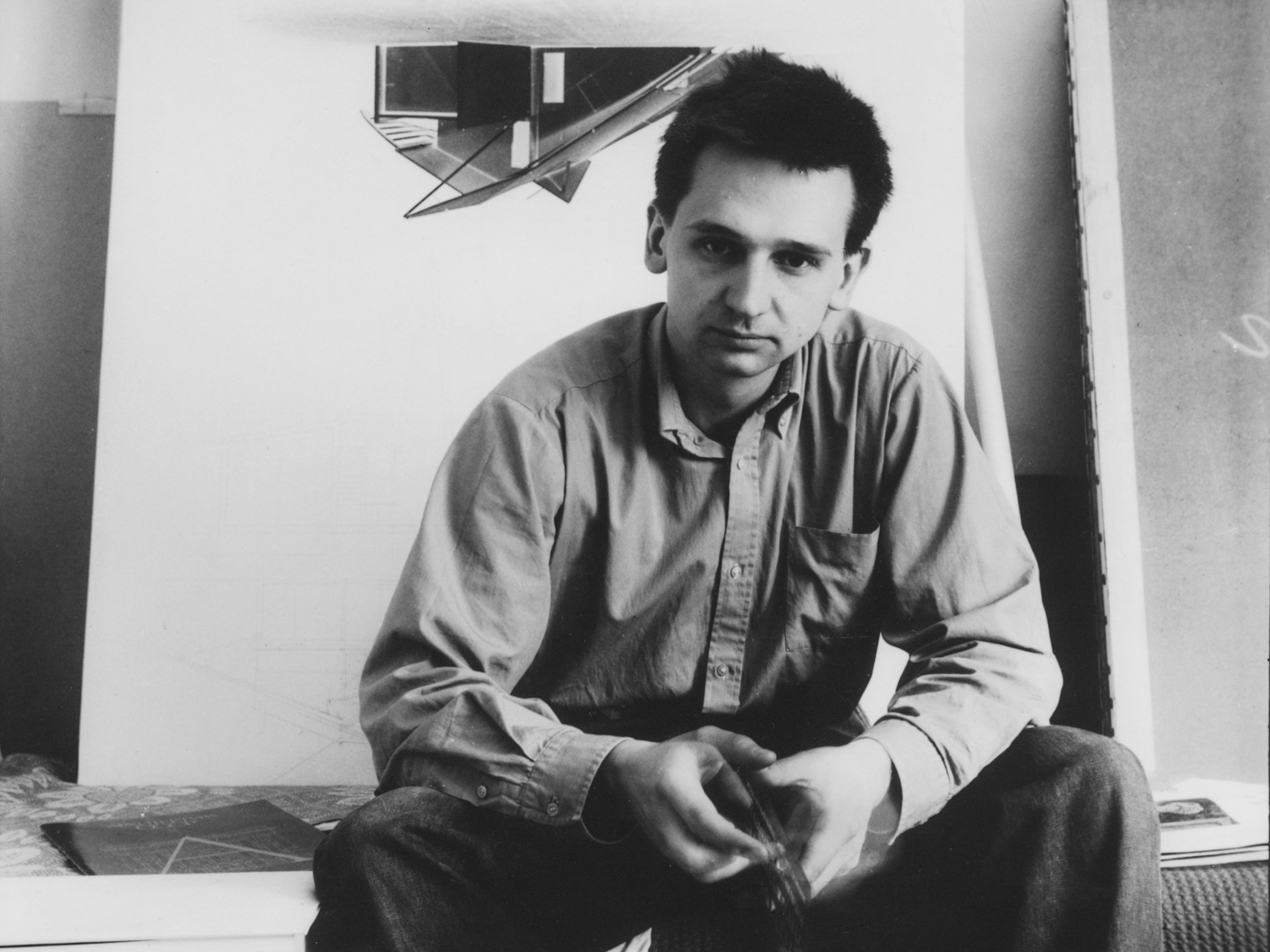
Valdas Ozarinskas (1961–2014) was an architect, designer, and conceptual artist, and one of the most prominent figures in contemporary Lithuanian culture. His work does not belong to the past – it continues to influence, provoke, and pulse with energy, irony, and radicalism.
Since the early 1980s, Ozarinskas created installations, objects, and video works that combined architectural principles with performativity and conceptual thinking. He always operated ‘in between’ – between disciplines, between form and thought, between architecture and its critique. He merged spheres that usually remain separate: architecture and fashion, music and exhibitions, mundanity and conceptualism. For him, space was never merely an object – it was an action, a commentary, and a way of thinking about the world.
While working at the Contemporary Art Centre (CAC) in Vilnius, Ozarinskas developed a unique language of exhibition architecture – subtle yet radical. His approach to exhibiting art did not function as a neutral backdrop, but as an independent narrative: space itself became an instrument of thought. Later, in the late 1980s, he joined the architectural collective Privati ideologija (Private Ideology), which challenged conventional ideas about architecture and its relationship with society.
Ozarinskas’s work was driven by a constant desire to subvert the system from within: from the legendary Vilnius nightlife interiors Neperšaunama liemenė (Bulletproof Vest) and the NATO’s bar, imbued with the irony of war aesthetics, to the Lithuanian Pavilion at EXPO 2000 in Hanover, where state representation was transformed into a conceptual experiment. These projects became classics not only because they shaped space, but also because they commented on the time in which they were realised.
Ozarinskas lived inside his creative practice – not as a metaphor, but as a system in which everything was connected. Nonconformity was not merely a stance – it was a way of thinking, a form of reaction, a flow of energy. His world was coherent: from objects to daily life, from clothing and posture to environment, all elements belonged to the same system, marked by rigour and precision. Work suits, uniform silhouettes, industrial motifs, militaristic symbols, and the simplicity of objects became deliberate signals – a form of expression in which style became a mode of thinking. His entire system of existence was carefully calibrated, yet always ready to explode.
Although Ozarinskas frequently collaborated with talented co-authors, every project he touched bore his unmistakable conceptual and aesthetic imprint. He was the driving force behind collective creativity – a powerful generator of ideas who could inspire entire teams and turn the creative process into a shared field of action. He attracted energy that brought together diverse fields and people. He was the nucleus of ideas – connecting, provoking, and inspiring – yet his vector of thought, his tone, and his sense of scale remained identifiable everywhere. Even in collaborative work, he remained unmistakably present through his direction, intensity, and unique inner drive.
The scale of Ozarinskas’s thinking was a defining aspect of his personality. He could think with equal clarity about a helicopter or an exhibition at the CAC, a nuclear reactor or a table. His imagination always operated on a broad, detached, cosmic scale – from the human body to the city, from technology to the cosmos. He was drawn to physics, energy flows, engineering processes, and the idea of flight – from real aircraft to utopian constructions blending art, science, and irony. He perceived architecture not as buildings, but as a phenomenon: a field of action connecting people, mechanisms, and the world.
Ozarinskas’s legacy is not an archive, but a living field – an energy that continues to influence, provoke, and inspire. It reminds us that art is not about tranquillity or decoration: it is movement, inquiry, and a constant invitation to see the world differently.
Elena Ozarinskaitė
Photograph: Gintautas Trimakas, 1986
Cabinet, video (fragment), 2006. Total duration: 64 min