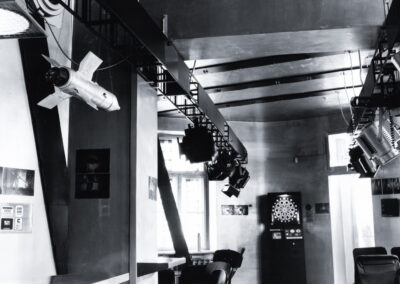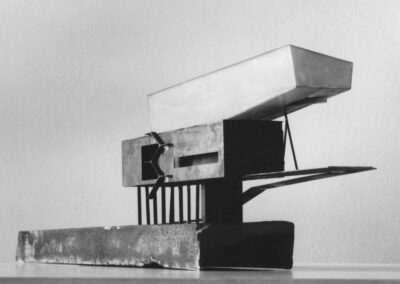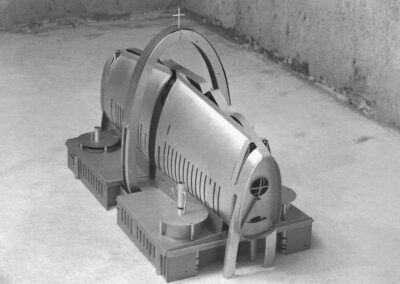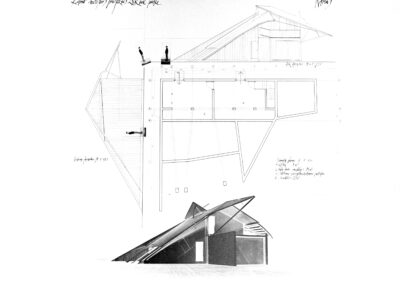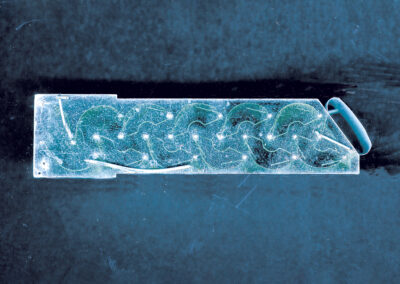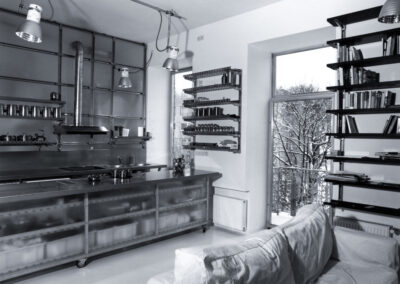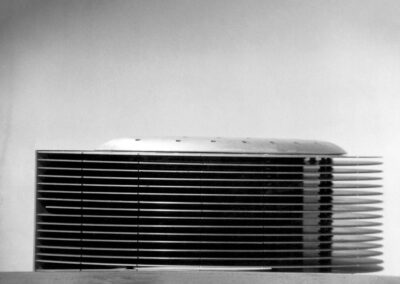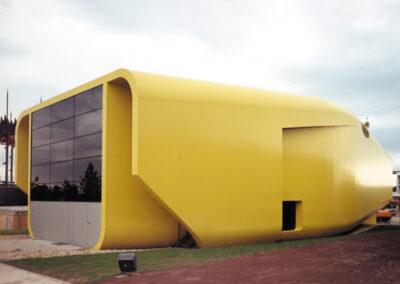
CAC foyer, 2006. Cinema Hall, 2012
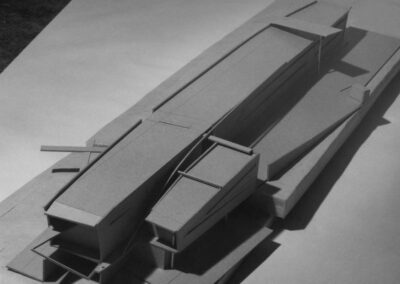
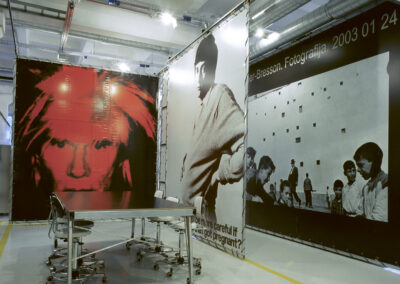
The 2006 renovation of the CAC foyer stands as one of the most striking architectural projects realised by Valdas Ozarinskas, demonstrating both his capacity and his determination to treat functional space as a conceptual manifesto. The gradual transformation of the foyer was not merely an interior refurbishment; it was an aesthetic and social experiment. As Ozarinskas himself observed, ‘architecture constantly tests people, and that is not pleasant.'[1] This remark encapsulates the project’s core idea: architecture is never neutral. By regulating movement and patterns of use, it shapes social choreography as well as emotional and psychological responses.
The modernist foyer designed by Vytautas Edmundas Čekanauskas embodied the formality characteristic of many public interiors of its time. As an architectural typology, the foyer functions as a transitional space – at the CAC, a passage from everyday street life into the culturally charged realm of the gallery. Ozarinskas does not reject the power of this transition, but he adopts a different strategy. Instead of leading from street realism to institutional culture, the foyer opens onto a form of magical realism, receptive to interpretation and subjective experience. This mode of welcoming the visitor – liberated from hierarchy and formality yet retaining symbolic intensity – has become an integral part of the CAC’s identity.
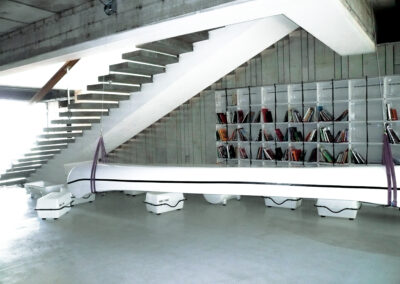
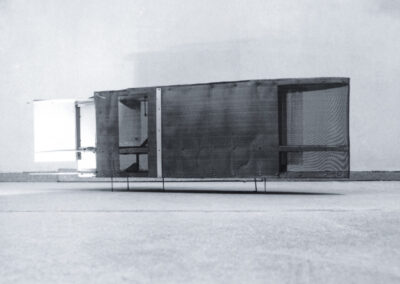
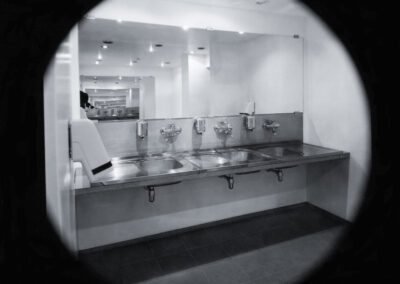
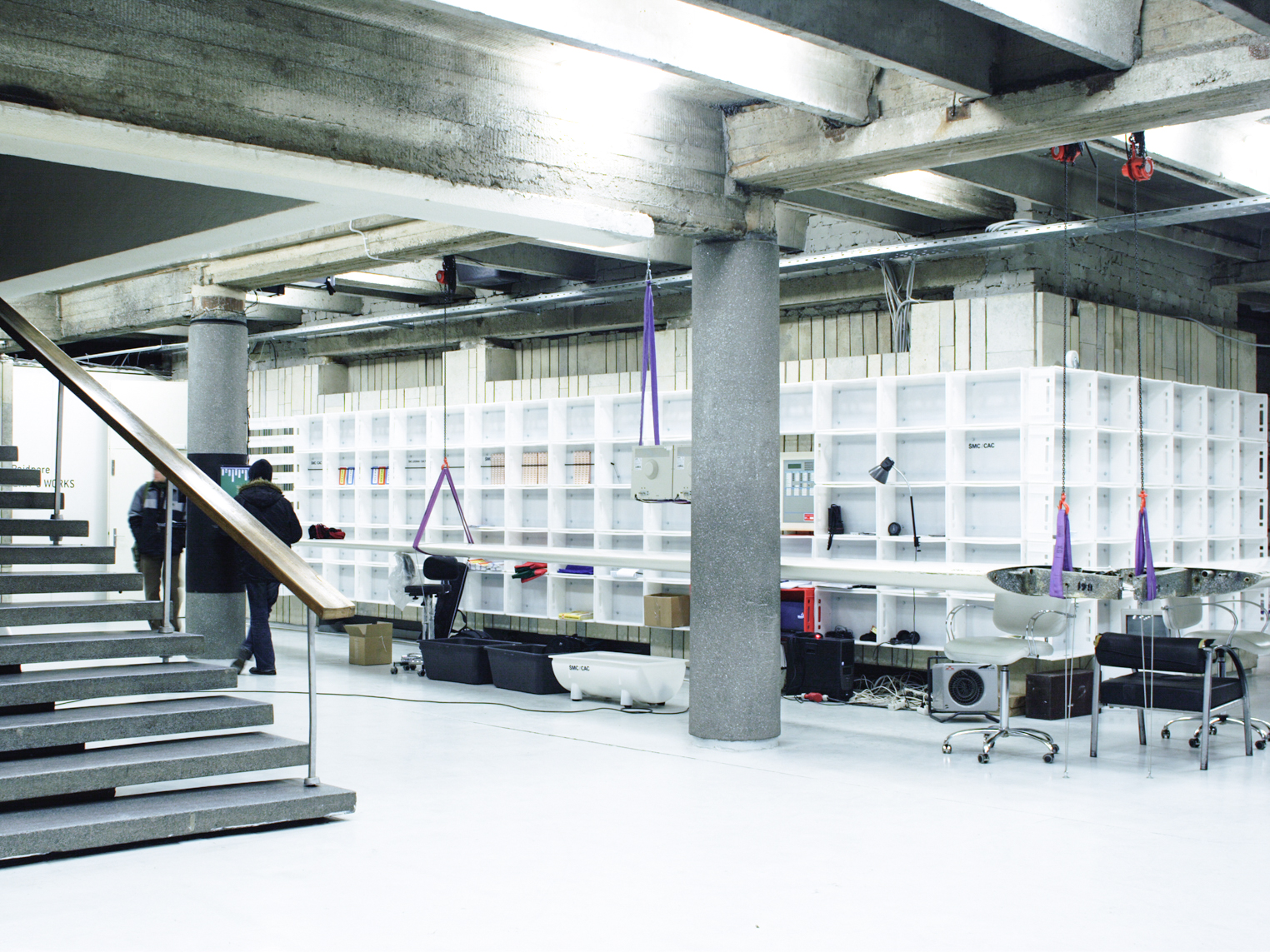
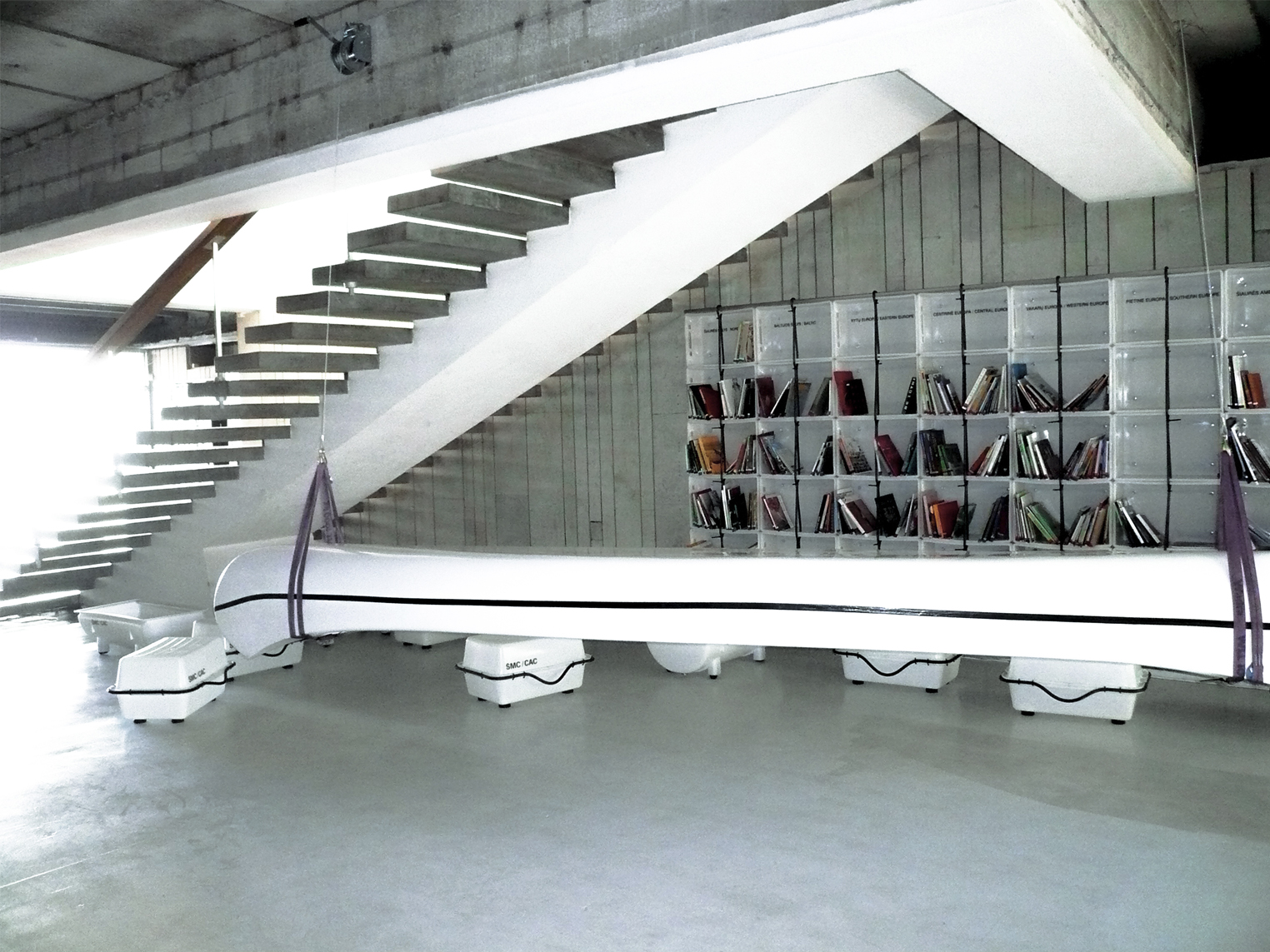
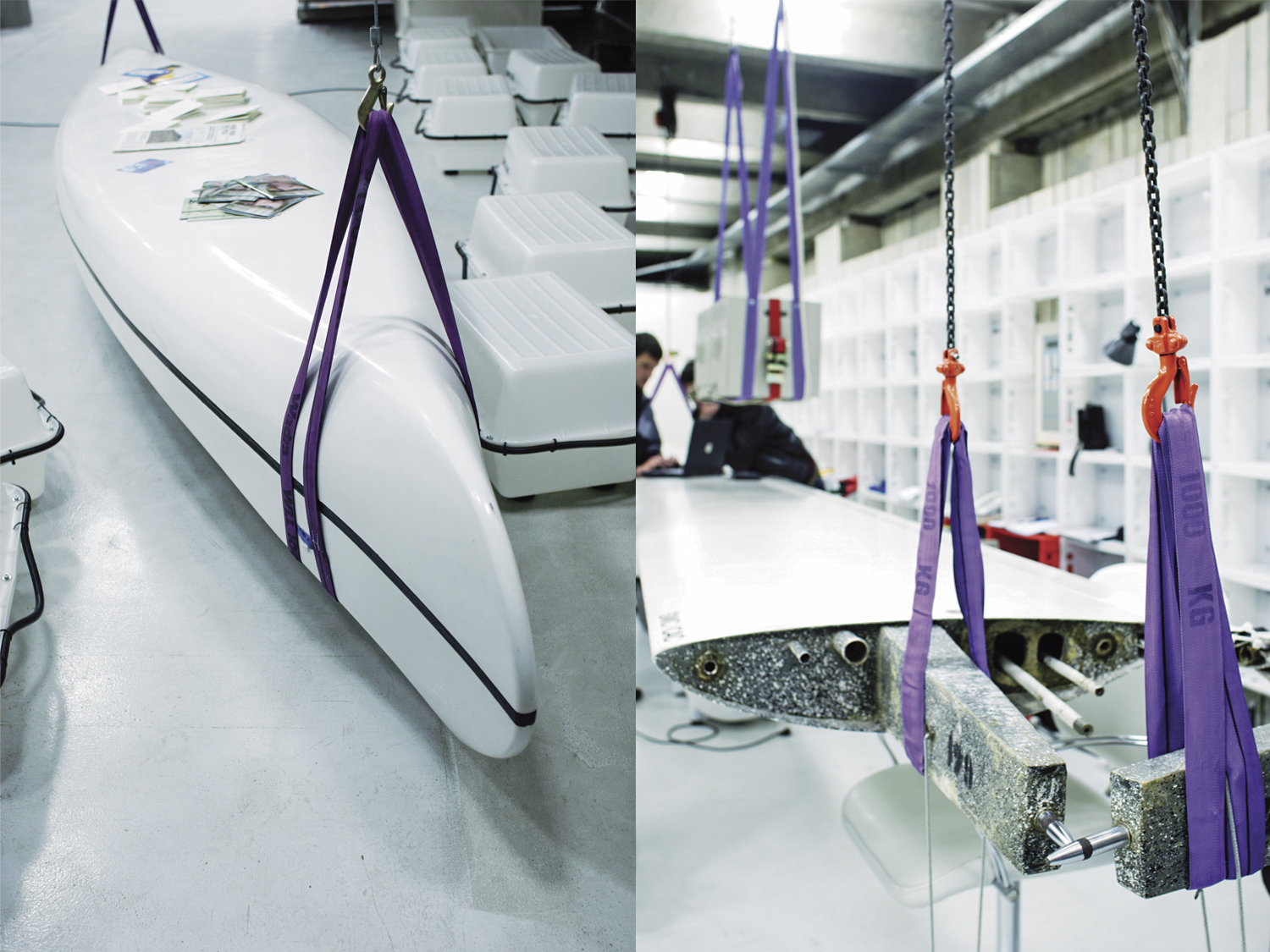
The essence of the reconstruction emerged most clearly in its details. Authentic ceilings and decorative elements that concealed the building’s raw structural surfaces were removed and replaced with objects drawn from everyday and industrial contexts. Standard white plastic boxes used in the food industry were repurposed as shelves, display cases, mailboxes, or pouffes; aeroplane wings became ticket-counter surfaces; and a kayak, suspended by ropes, functioned as an unstable piece of interior furniture. According to Ozarinskas, these details reflected his vision of a loft-like space: ‘I can’t imagine having anything more or less in my home than there should be in the CAC lobby – and vice versa.'[2]
The creative reconstruction was also shaped by poetic metaphors. As Agnė Narušytė observed:
Thanks to him, the CAC vestibule became a metaphor for flight – across the Atlantic, across artistic quarrels, across our own boundaries. I hope it will remain so: exhibition annotations will continue to hang on an aeroplane wing, and catalogues will lie in milk crates. That wing is another gesture whose simplicity of form conceals a wealth of meaning.[3]
Through this transformation, the architecture became more than an entrance space; it became a cultural commentary on the functional logic of a contemporary art institution.
Another crucial aspect of the reconstruction was the treatment of the floor. Ozarinskas repainted the marble pattern in a neutral grey, allowing only fragmentary traces of the original surface to remain visible:
The greyish (almost white) paint settled over the old CAC floor’s pompous beauty – the mosaic-like ‘marble’ covering. The old floor is no longer visible, yet it is undoubtedly still there. When the light falls sideways, its texture can even be discerned. One might say that Ozarinskas’s carpet of neutrality is almost transparent.[4]
This gesture foregrounded temporality – the persistence of layers and traces of time that, recalling the logic of Kim Ki-duk’s 3-Iron (2004), in which presence is defined through absence.
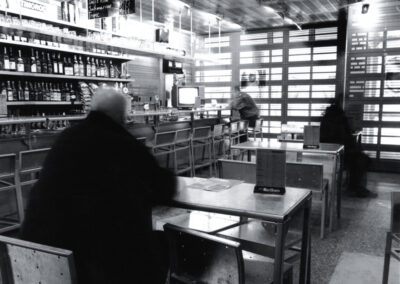
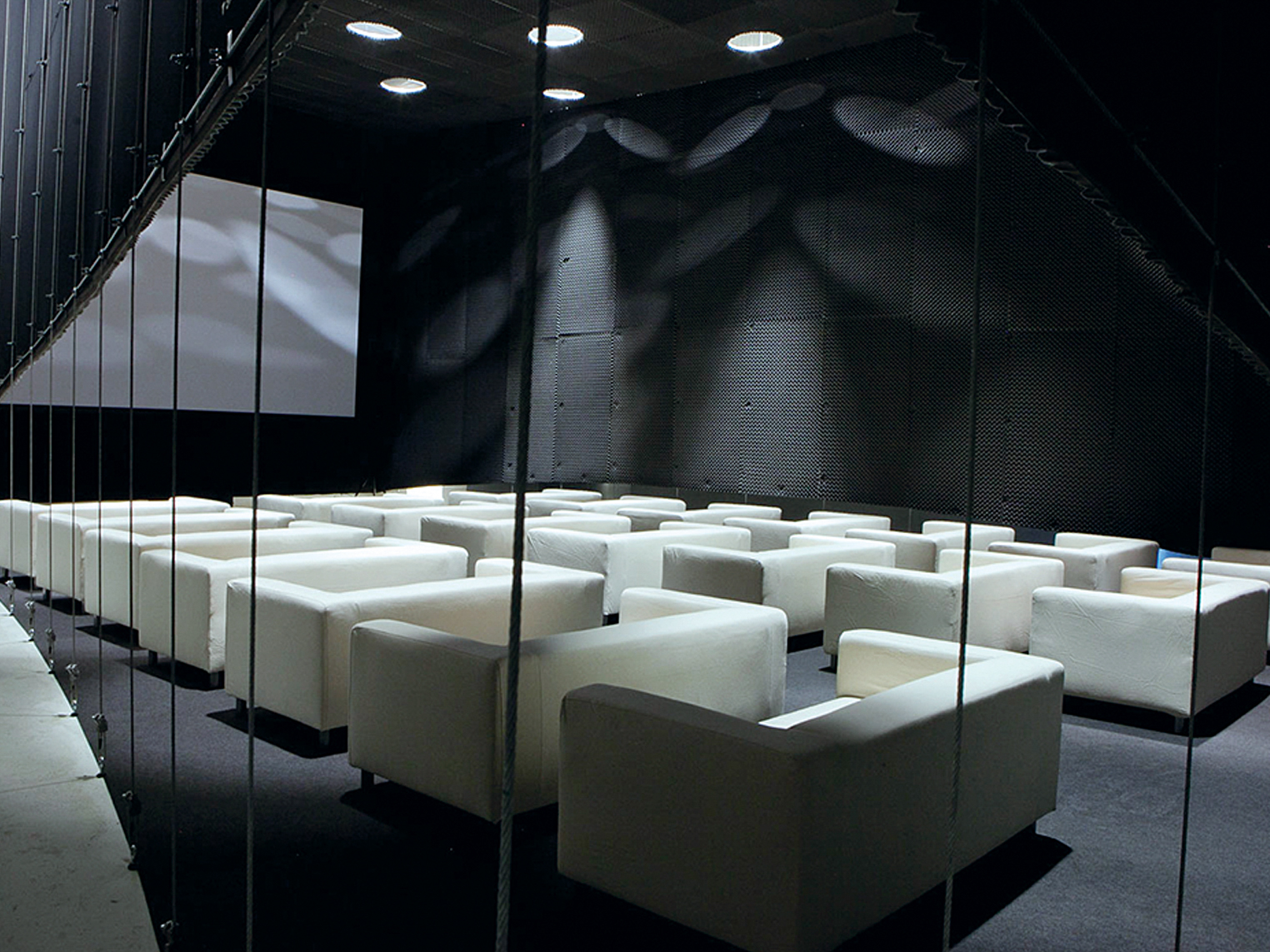
The foyer reconstruction is closely connected to other interventions by Ozarinskas at the CAC. The last project linked to his legacy is the Cinema Hall, renovated in 2012 in collaboration with Audrius Bučas. By questioning the boundaries between public and private space, the designers introduced several sofas, ‘easily recognisable as IKEA products,’ luring visitors ‘into thinking of the space as analogous to their living room where they might relax and casually watch television even as the CAC’s programming was bound to be avant-garde and provocative.'[5] Through such gestures, Ozarinskas transformed the CAC from a mere institutional framework into a permanent creative testing ground, where architecture, design, and art converge into a single critical and provocative whole.
[1] Januškevičiūtė, V., ’Scenarijai viešosioms erdvėms’, Architektas be architektūros?, Valdas Ozarinskas Retrospective: Exhibition Guide, ed. Virginija Januškevičiūtė, Vilnius: Contemporary Art Centre, 2018, p. 14.
[2] Januškevičiūtė, V., ’Fojė’, Architektas be architektūros?, Valdas Ozarinskas Retrospective: Exhibition Guide, ed. Virginija Januškevičiūtė, Vilnius: Contemporary Art Centre, 2018, p. 36.
[3] Narušytė, A. 2014, ‘Architekto mostai. In memoriam Valdui Ozarinskui (1961–2014)’, 7 meno dienos, https://www.7md.lt/tarp_disciplinu/2014-12-19/Architekto-mostai
[4] Dubinskaitė, R. 2006, ‘Šviečiantis, plaukiantis ir skrendantis fojė. Valdo Ozarinsko interjerai ŠMC’, 7 meno dienos, https://www.7md.lt/archyvas.php?leid_id=719&str_id=6184
[5] Varnelis, K. XXXX, Stalker Architecture: Design and (Private) Ideology (Valdas Ozarinskas), https://varnelis.net/stalker-architecture-design-and-private-ideology-valdas-ozarinskas/.
– Vaidas Petrulis
Reconstruction of the CAC Foyer (2006)
Author: Valdas Ozarinskas
Photographs: CAC Archive
Realised at the CAC, Vilnius. No longer extant.
Other sources:
Emission. Catalogue, Contemporary Art Centre, Vilnius, 2006
Reconstruction of the CAC Cinema Hall (2012)
Authors: Valdas Ozarinskas, Audrius Bučas
Photographs: CAC Archive
Realised at the CAC, Vilnius. No longer extant.
Other sources:
Delfi, ‘ŠMC atidaro savo kino salę’, 2012, https://www.delfi.lt/kultura/naujienos/smc-atidaro-savo-kino-sale-59456903
Architecture